Find anything
Search the whole guide
Search concepts, patterns, frameworks, benchmarks, failure modes, playbooks, glossary terms, and curated paths.
Orientation
The field gets easier when you separate loop, tools, state, and evals.
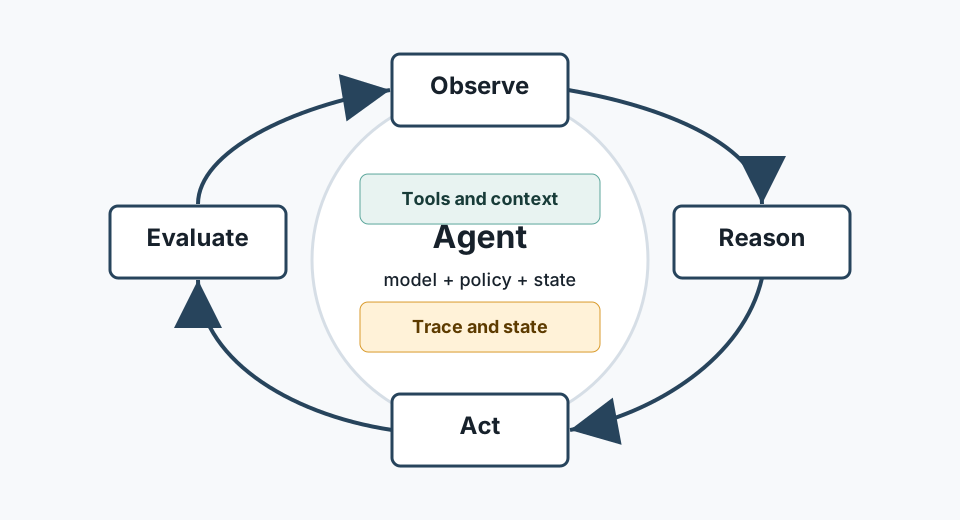
Agentic AI sounds slippery because people use one word for many things: a function-calling chatbot, a workflow graph, a browser operator, a coding worker, a multi-agent team, or an app platform. This guide keeps those layers separate.
Concept map
The primitives that make agents legible
Read these cards as the stable vocabulary. Frameworks change faster than these concepts.
Stack view
What sits around the model
Patterns
Architectures are control surfaces
Use the smallest pattern that exposes enough control, state, and verification for the task.
Interactive tool
Architecture builder
Pick a workload and risk surface. The recommendation changes with tool and memory scope.
Ecosystem
Frameworks and protocols are different layers
MCP and A2A are interoperability protocols. Frameworks are implementation choices.
Interactive tool
Framework chooser
Filter by the kind of control surface you need. Treat this as orientation, then run a one-day spike.
Current radar
The field is moving fastest around operational agents
These cards are intentionally volatile. They track what looks genuinely useful now, what is worth a small spike, and what future agents should re-check before promoting into the stable guide.
Interactive tool
Trend signal filter
Filter the radar by usefulness signal. The labels are conservative, not hype scores.
How to use it
Start with proven useful, then scan useful now. Treat promising and watch as areas to revisit during refreshes.
Latest information
A dated ledger for what changed and how the guide responded
This section lists source publication dates, last-edited dates when available, and the date this guide assessed the item. Raw candidates live in the update buffer before weekly analysis promotes them into the website.
Reliability
Evaluate the trajectory, not only the final answer
Agent systems fail in the path: wrong tool, hidden state, missing approval, stale context, or brittle policy handling.
Interactive tool
Failure-mode simulator
Select a failure mode and see symptoms plus mitigations.
Interactive tool
Eval checklist generator
Choose the areas you want to harden. The generated checklist is intentionally concrete.
Practice
Grow from beginner to operator by building small inspectable systems
The fastest learning path is not a framework tour. It is one useful agent, one trace, one eval suite, then one controlled workflow.
Vocabulary
Terms worth making precise
Use this as a jargon decoder while reading papers, specs, framework docs, and product notes.
Interactive tool
Jargon decoder
Pick what you are reading, then use the focus terms to decode the vocabulary in context.
Resource library
Papers first, docs and specs for implementation truth
Papers carry the conceptual and benchmark evidence. Official docs and specs carry current product, API, and protocol behavior.